|
In
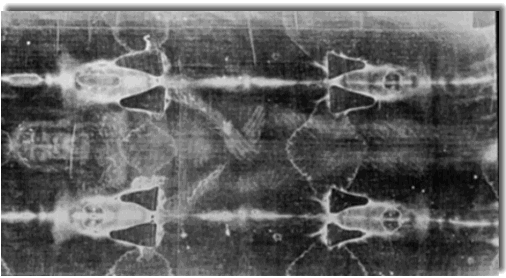
1898, Secundo Pia took the first photograph
of the Shroud. On the photographic negative, he was
able to observe a positive image of the man in the
Shroud.
A negative is
a positive, thus the real photographic negative
shows a "optic positive" of the man of the Shroud.
This
photographic analysis points to the
possibility that the image, no matter how it was
formed, was produced by a real body.
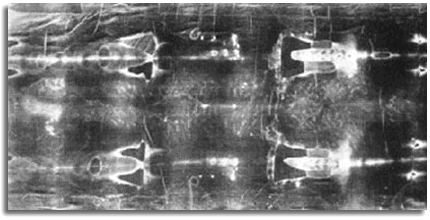
One of the most striking characteristic of
the image is that it encodes three-dimensional
information, something that can not be found in
paintings or photographs. When processing the
image with an image analyzer, we can extract three-dimensional information, (anyone can do it
with the appropriate computer software) it shows a
human body in 3-D. The body parts that were closer to
the cloth can been seen in relief from the parts more
distant to it. The intensity of the image is inversely
proportionate to the body-cloth distance in each
point: the image is darker (lighter in the negative)
in those areas where the distance body-cloth was
smaller. This rule is mathematically true for the
entire image, and it has been calculated that the
distance between the body and the cloth could not have
been more than 3.5 cm. From this analysis it can be
easily concluded that the image was not a
result of direct contact between body and cloth,
such that we would only have the image of the
body parts directly in contact with the Shroud. |